The enclosure is not the instrument. The horn is.
Most monitors treat the front panel as somewhere to mount drivers. Here it is the acoustic device: one curved surface that loads the compression driver, terminates four bandpass chambers, and sets the radiation pattern of both bands at once. Everything behind it exists to serve that surface.
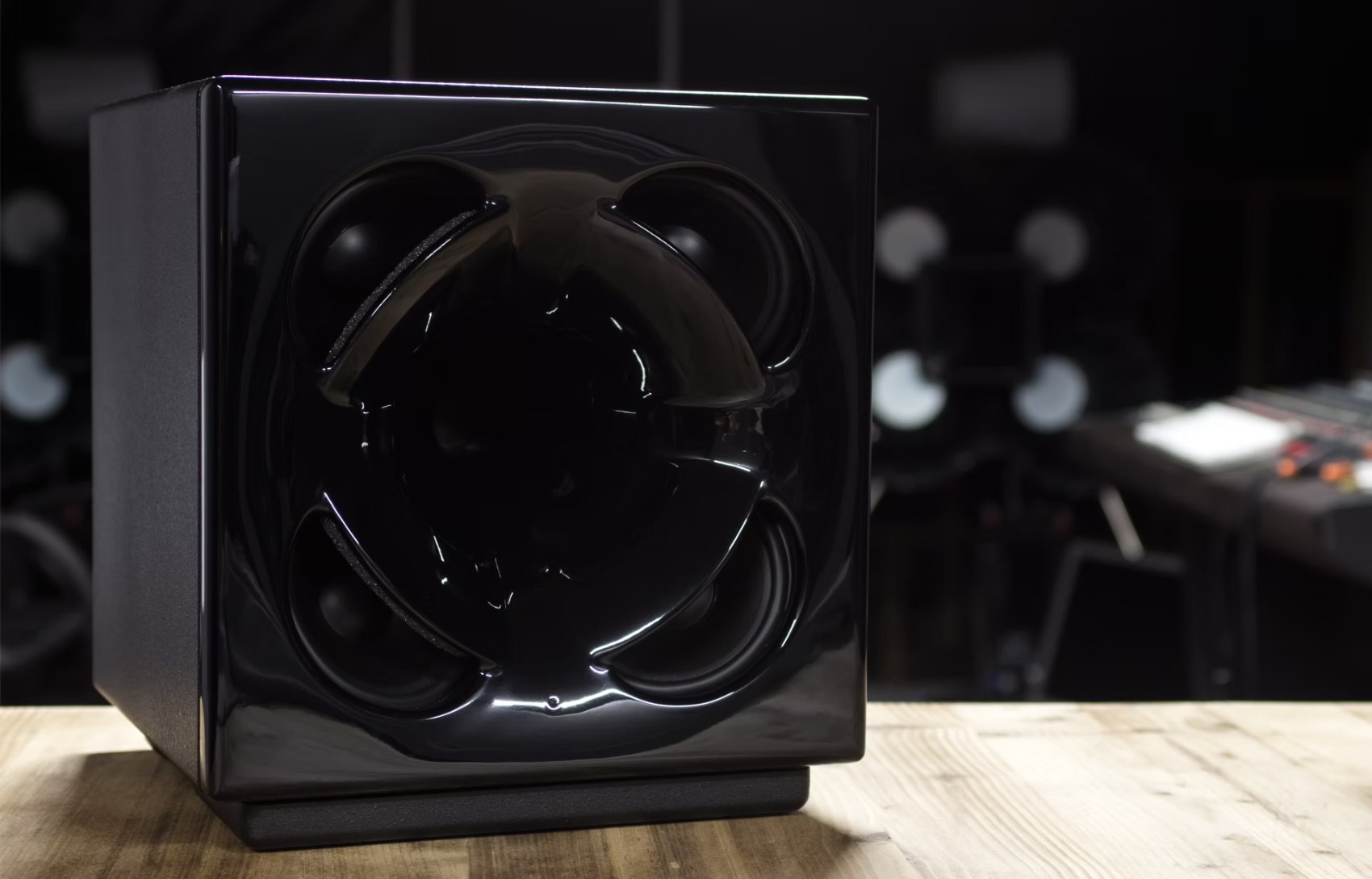
Square Two
Powered two-way studio monitor. A 32-centimetre cube, 19.4 kg, 250 watts low and 100 watts high from a Hypex FusionAmp. Bass reflex as standard, convertible to sealed.
{{ p.body }}
One idea,
four ways to build it.
Every Reflector loudspeaker puts a reflector between the driver and the room. What changes is the scale of the room and the amount of pressure it has to fill. The plot places the families accordingly.
{{ sel.body }}
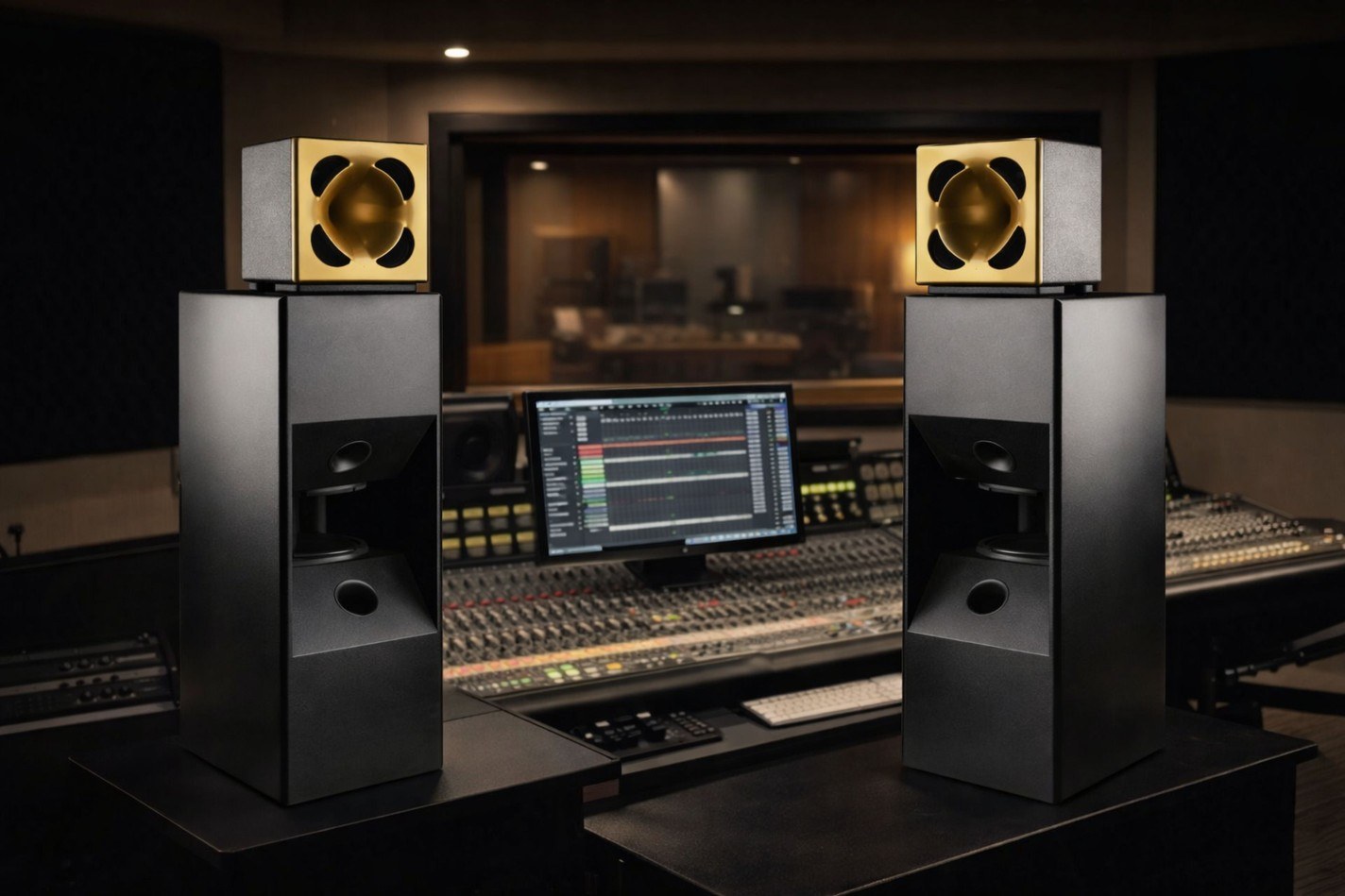
A 32-centimetre cube with a horn where the baffle should be.
Height, width and depth are all roughly 32 cm. Inside, four five-inch woofers with eight-gram moving mass fire into bandpass chambers that open at the four corners of the horn; an Italian compression driver loads its throat. At working distance the pair behaves as two points, not eight drivers — which is the whole reason to build a coaxial in the first place.
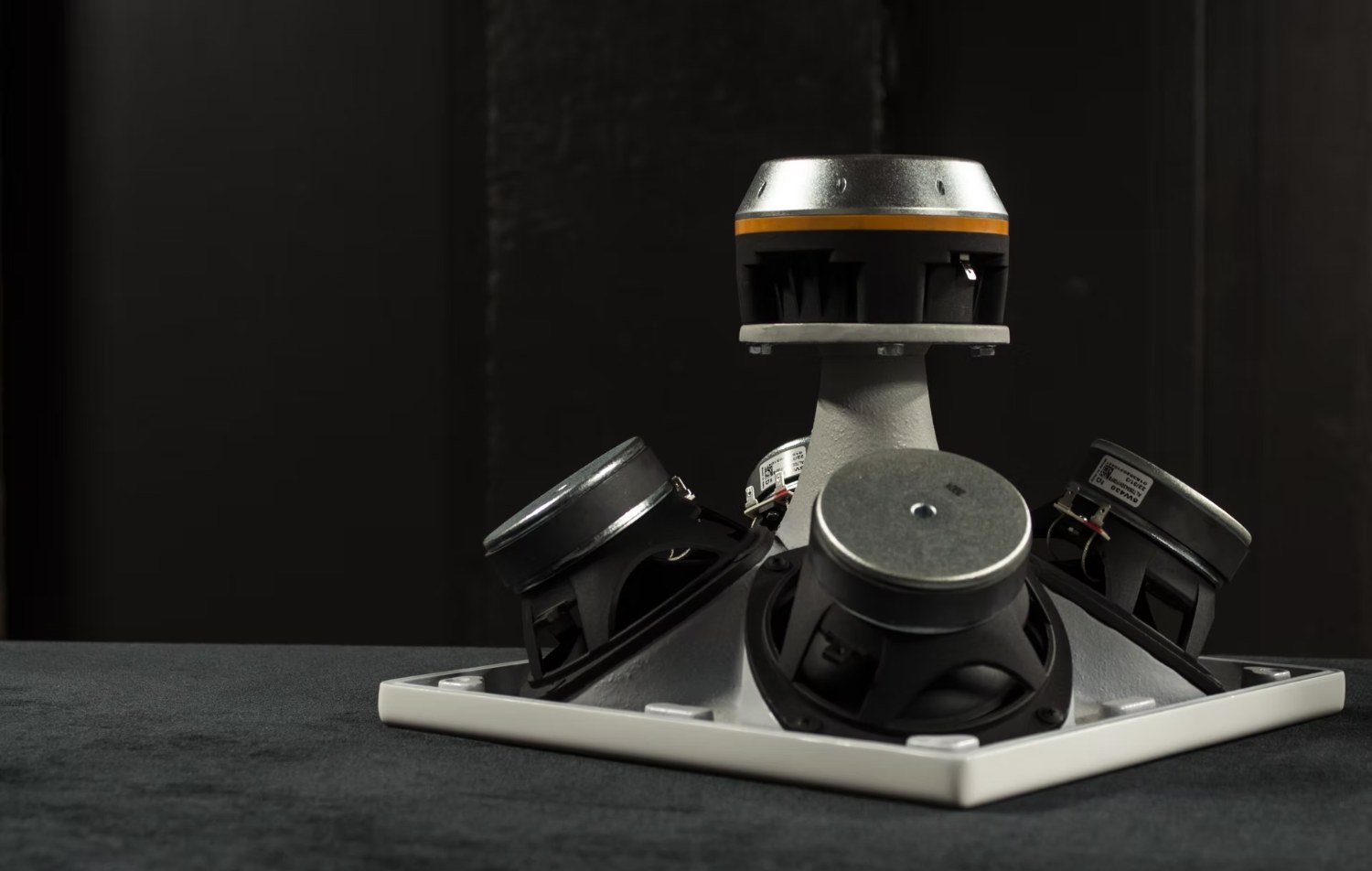
Crossover, driver equalisation and protection run in the amplifier's DSP, splitting at 1 kHz. Phase linearity from about 200 Hz upward is reached with ordinary IIR filtering rather than FIR — no added latency, and no pre-ringing arriving ahead of the transient. Response ripple measures ±1.3 dB.
Square Two ships as bass reflex and converts to sealed. It is a real choice with a real cost, and the monitor is designed to be switched either way in the room it will live in.
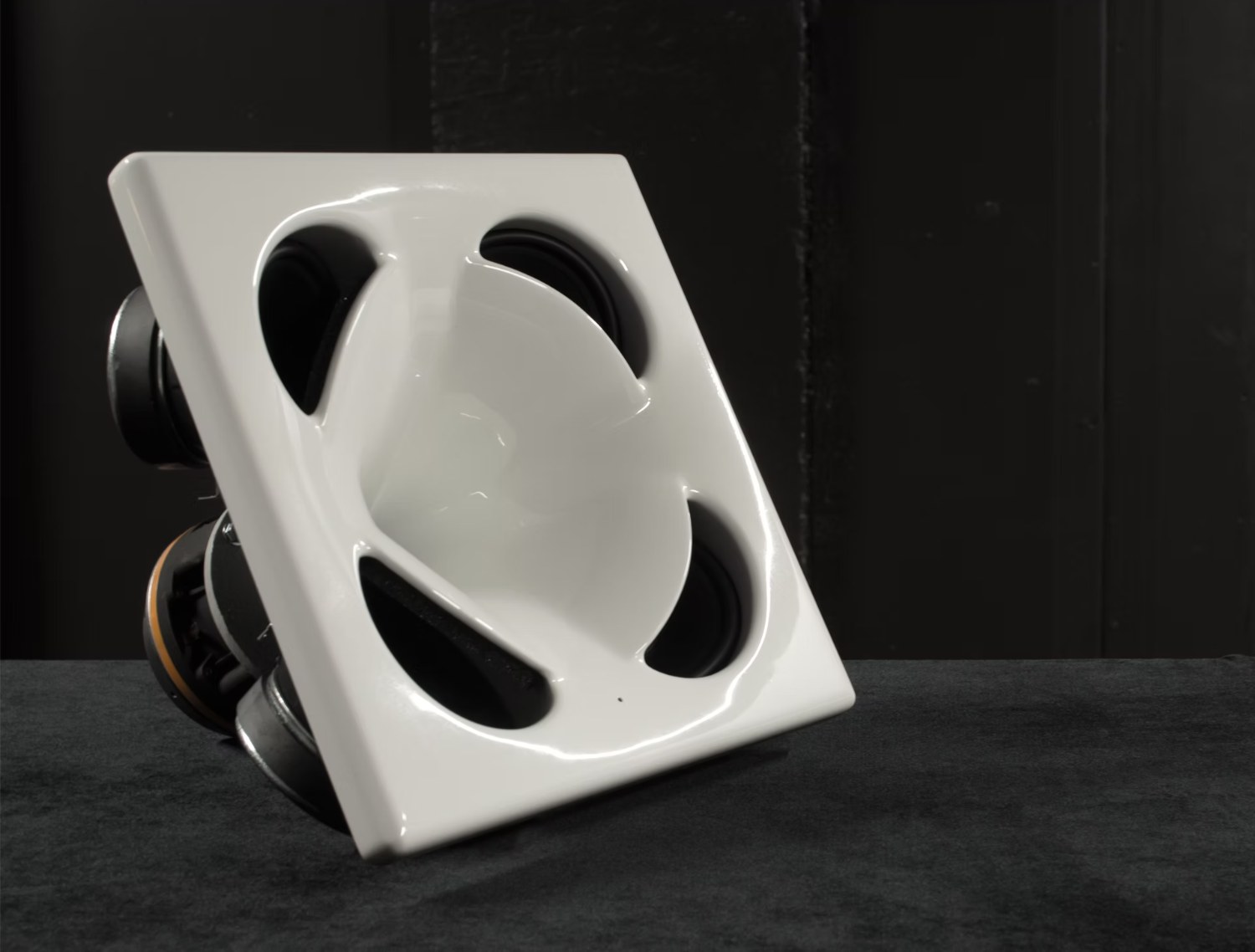
The horn is machined aluminium and it is the only part of the monitor anyone in the room will look at. Its colour is specified per order.
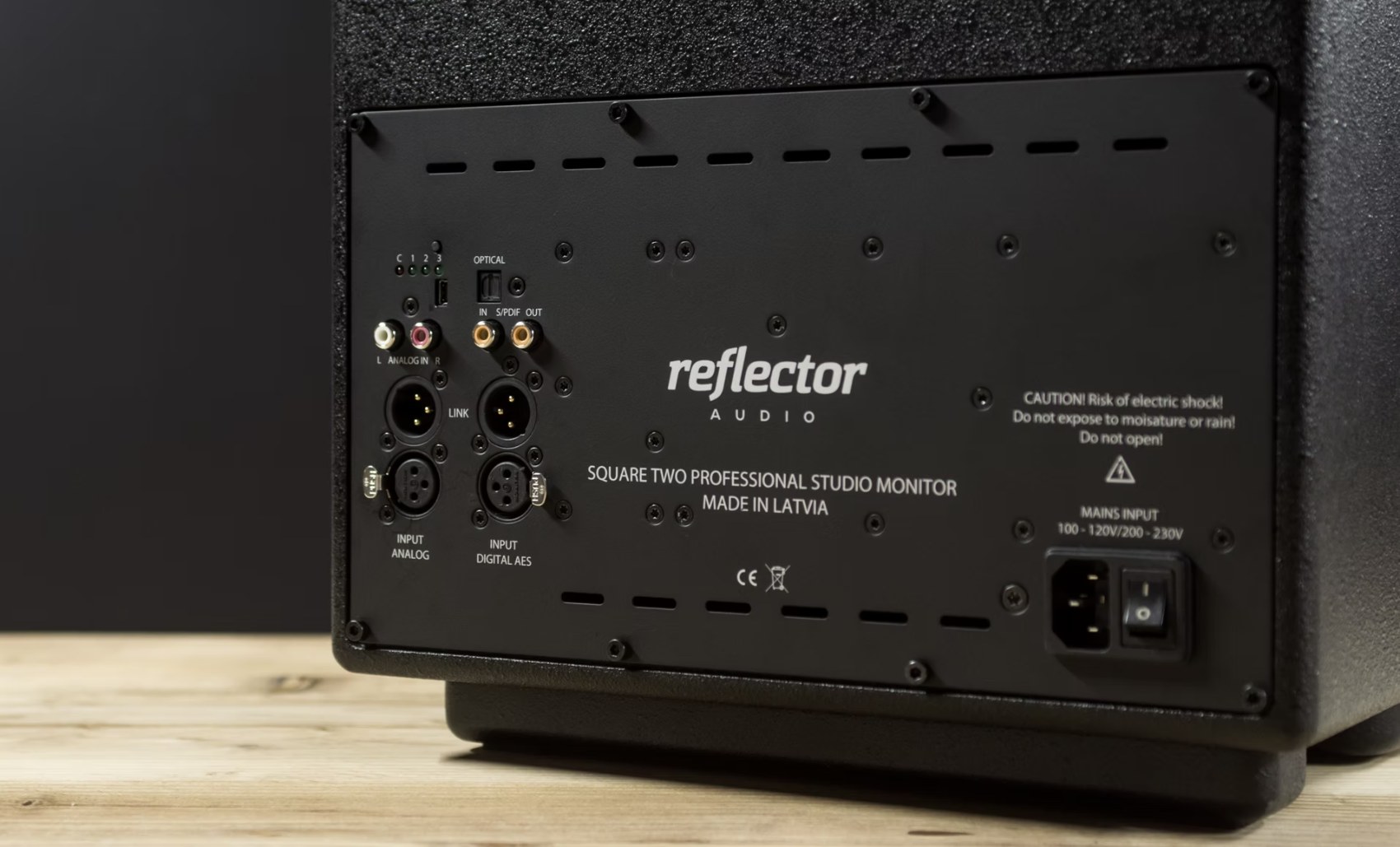
Analogue and digital inputs are both fitted, with a link output for the second monitor. Mains is universal, so a pair travels between regions without a shop visit.
Four things the horn decides.
Each field below is a live model you can push around, paired with the measurement it corresponds to. The plots are the real ones, taken in an anechoic chamber.
Reflection
A horn is a mirror for pressure. Its curve was drawn so that the compression driver's response and the four woofers' output land on the same wavefront leaving the mouth — matched in phase and in frequency, on axis and off it. Illuminate too little of the surface and the mouth is under-used; too much, and the edges of the beam start to cross.
Phase
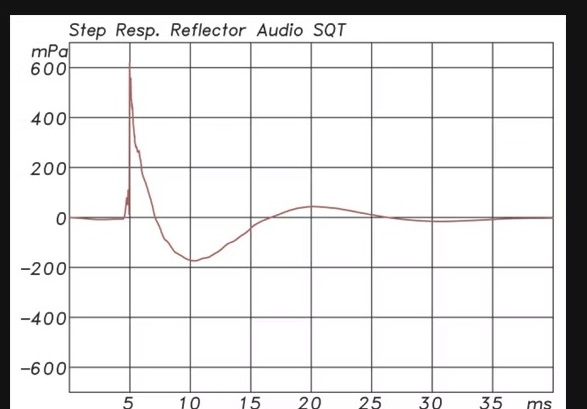
Two sources of the same signal do not make twice the sound. They make a standing pattern of reinforcement and cancellation that depends on the distance between them. Square Two removes that distance mechanically, then holds phase linear from roughly 200 Hz up with IIR filters. The step response is the proof: the jump starts where the signal starts, with nothing arriving before it.
Pattern
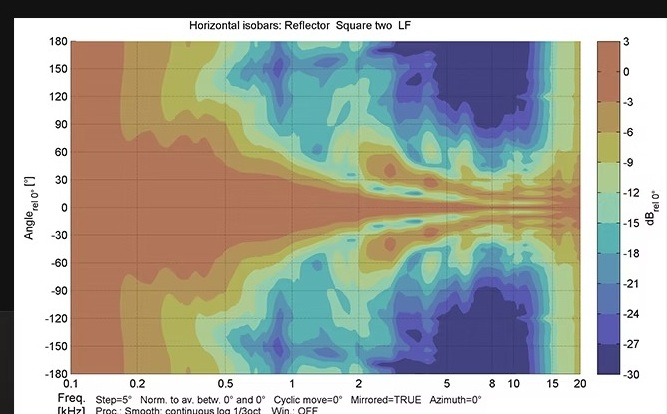
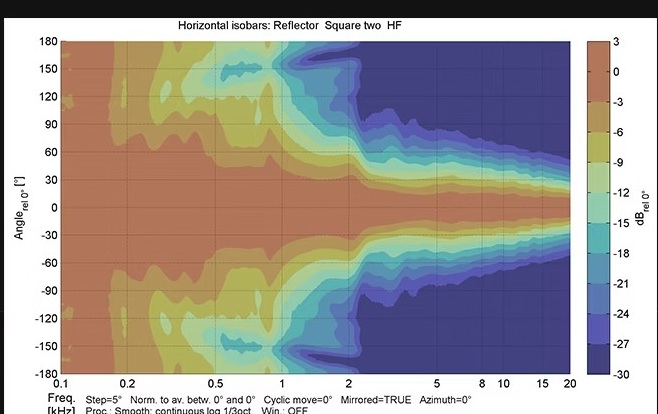
Every driver stops radiating into the room and starts throwing a beam as frequency rises. If that happens abruptly, the reflected sound reaching the desk a few milliseconds later carries a different tonal balance from the direct sound, and no amount of treatment repairs it. Nominal directivity here is 60 by 60 degrees, and the isobars below show both paths holding it through the crossover.
Decay
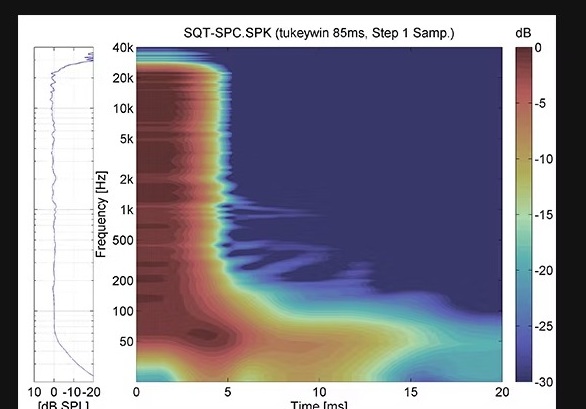
What a monitor does after the signal stops matters more than what it does during. Energy still leaving the box arrives late and uncorrelated, and reads as thickness. This is the one place where the enclosure choice is audible: reflex holds more energy for longer in exchange for output, sealed lets go sooner and gives some level back. Excite the field, then watch how long it takes to be still.
Reference is
a working distance.
A coaxial is at its most useful close up, where a multi-way loudspeaker would still be several separate sources. In listening tests the ideal spacing between Square Two and the engineer landed at three to four metres — far enough for the pattern to establish, close enough that the room stays out of it.
Two DSP sections. You are trusted with one of them.
The first section carries driver equalisation and the crossover. It is not user-accessible, and it is the reason two monitors built a year apart still match. The second holds three presets for the room — selected at the back, indicated on the front, and changed as often as the room needs.
{{ p.body }}
In an anechoic chamber, with absorbers laid on the floor to remove the one reflection that room still has. Frequency and phase response, horizontal isobars, cumulative decay and step response were taken in the same session; the full report travels with the brochure rather than being summarised into a single flattering curve.
Measured, then published.
Anechoic, half space, on the design axis unless stated. Maximum SPL to EIA-426B. The plots below are reproduced as they were taken.
¹ Anechoic, half space. ² Maximum SPL per EIA-426B. ³ Phase linearity quoted from approximately 200 Hz upward. Figures are those published by the manufacturer and by the independent anechoic report; specifications subject to change.
Priced by specification.
Each pair is configured before it is built: enclosure mode, front panel colour, mains region, and what happens on the day it arrives. Distributors issue the final quotation. The figure on the right is indicative.
Received. Your nearest distributor replies with a firm quotation and a delivery window.
Indicative retail per pair. Final price, tax and delivery are quoted by the distributor for your region.