The speaker that refused a cabinet.
For eighty years a loudspeaker meant a driver in a sealed volume of air. In 2009, in a workshop in Latvia, a small group built the thing that argues with that — and then spent more than a decade making it manufacturable.
What you have been hearing is furniture.
A cabinet does two jobs. It stops the back wave of the driver from cancelling the front wave, and it holds everything in place. It also, unavoidably, stores energy in its walls and gives it back a few milliseconds later, coloured by whatever the walls are made of.
That late energy is what most people mean when they describe a loudspeaker as warm, or dry, or fast. It is not the recording. It is the box having an opinion.
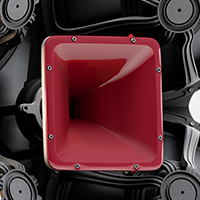
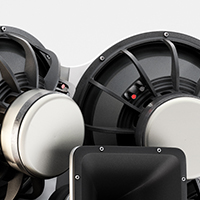
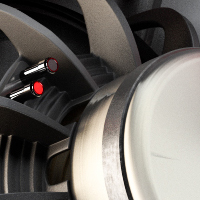
Reflector's answer was to remove it. The woofers are mounted in open air and radiate front and back in a figure of eight, which cancels to the sides and gives the room far less to work with. Above the crossover a compression driver on a horn takes over, arranged coaxially with the low-frequency drivers so the whole face behaves as a single source.
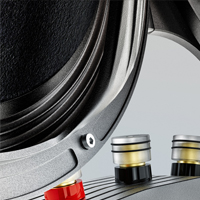
On Square Two — a cube roughly thirty-two centimetres on a side — four woofers vent through individual openings around that central horn. Sound On Sound described it as a horn-loaded concentric monitor forming a virtual point source.
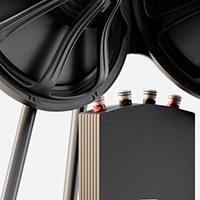
None of this is free. An open dipole needs room behind it, needs far more amplifier than a sealed box, and needs correction in the time domain rather than only the frequency domain. The Q1818 answers with roughly ten kilowatts of passively cooled Class D amplification and DSP management, tuned per control room.
Which is why nothing is sold from a shelf. Every system is specified against the room it will live in, and the measurement stays with the serial number.
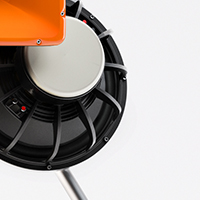
Remove the box and you remove its opinion. What is left is the recording, and the room you are sitting in.
{{ m.tag }}
Come to Riga, or we will come to you.
Demonstrations run through distributors across Europe and directly out of New York and Los Angeles. Tell us the room and we will arrange the nearest one.
Six, and no more.
Installed and voiced
Shipped worldwide
{{ current.name }}
{{ current.long }}
Four woofers around a horn.
Reflector Audio Design, SIA is registered in Latvia and run by a small team drawn from high-end consumer audio, car audio and professional audio. The structural ideas behind the baffle-free designs were prototyped in 2009, several years before there was a company to put them in.
Research, manufacturing and quality control sit in Riga. Reflector Audio USA works out of New York and Los Angeles, where the studio systems are demonstrated and tuned. A United States patent covers the loudspeaker structural technology.
The portfolio stays deliberately narrow: Bespoke, Lite and Touch for listening, Q1818 and Square Two for rooms where the loudspeaker is a working instrument. Nothing in it is designed to be easy to build.
Heard at
Trade
Tell us about the room.
Dimensions, treatment, what you listen on now, and what is missing. Enough for us to say which model fits and where the nearest pair is.
{{ o.role }}
Reference {{ orderRef }}
Riga will write within two working days to confirm the build, the lead time, and where a pair can be heard before it is made.
Checkout
Jūrmala, Latvia