Square Two
$8,900Nearfield to midfield and mastering. 320 mm cube, 19.4 kg, 118 dB peak.
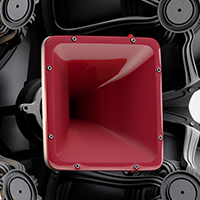
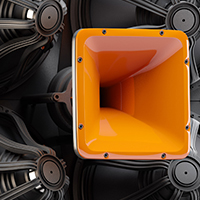
The entire front face is a horn. Four 5″ woofers vent through its flare, concentric with the 1.4″ compression driver at the throat. One source, measured as one source.
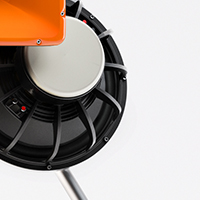
At close range that fails. The paths arrive separately and the image smears. Square Two removes the problem geometrically: the woofers sit on a sub-baffle behind the horn and vent through four apertures cut into its flare, arranged concentrically around the compression driver.
Because the baffle is square and the array symmetrical, horizontal and vertical directivity are identical — one isobar plot describes both planes. Crossover at 1 kHz. Linear phase from 200 Hz is produced with bell, shelf and all-pass sections rather than FIR, fifteen biquads per path.
Nearfield to midfield and mastering. 320 mm cube, 19.4 kg, 118 dB peak.
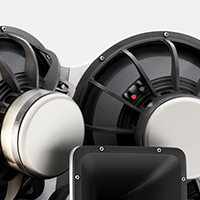
Large-format mains built to a room. Multiple 15″ woofers around a single horn.
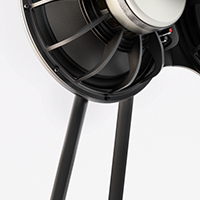
Decoupled console pads, floor columns and yoke brackets for the 320 mm footprint.
Independent laboratory measurement, class 1 anechoic chamber, 4 m, G.R.A.S. 46BF at 96 kHz / 24 bit. Not a summary of the results — the results.
Demonstration pairs travel. Tell us the room, the console position and what you are working on. We will arrange a listening at the factory in Rīga, at a partner studio, or in your own control room.
A 320 mm cube in which the entire baffle is a horn. Four 5″ Eighteen Sound woofers on a recessed sub-baffle vent through bandpass chambers in the flare; a 1.4″ Faital compression driver sits at the throat. Nearfield, midfield and mastering.
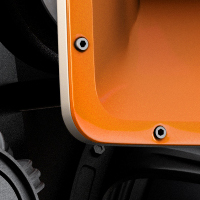
Pairs are matched to within 0.35 dB before they leave the workshop and shipped in a flight-rated case. Eight to ten weeks from Rīga.
A Bespoke system starts with the room, not the catalogue. We measure the space, model the boundary conditions, then build the enclosure, the horn and the crossover around the result. Throat colour is chosen at the same time as the filter set.
We measure the room, the listening position and the boundaries that will load the low end.
Horn flare, chamber volume and driver count are chosen against the measured room, not a datasheet.
Cabinets and horns are made in Rīga. Finish, throat colour and hardware are specified with you.
Installed and aligned in place, with the final filter set measured and documented for the room.
Tell us the room dimensions, the work you do in it and the level you need. We will come back with a proposal, a projected response and a price.
High-gloss polyester over machined MDF. Any RAL reference can be matched to order.
Horizontal and vertical behaviour are identical, so a single isobar plot describes the monitor completely. Above 600 Hz the opening angle is about 120°, narrowing to 90° at 1 kHz and to roughly 50° above 2 kHz.
Narrow is neither good nor bad — it is appropriate or inappropriate to the room. Less freedom of movement at very short distances; far less reflected energy and a smaller diffuse-field contribution. Three to four metres suits Square Two best.
Linear-phase response is usually bought with FIR filtering and paid for in latency. Square Two instead uses a combination of bell, shelf and all-pass sections — fifteen biquads per path on the Hypex platform — to hold phase linear from roughly 200 Hz upward.
The step response starts cleanly, with no precursor and an even decay. The spectrogram shows no resonant tail. For tracking and for live monitoring, the absence of FIR latency matters as much as the phase behaviour itself.
Four 5″ drivers should not reach 112 dB. They do here because each fires into a bandpass chamber that vents through the horn flare, raising sensitivity well above what the cone area alone would give.
Multitone measurement at an average music crest factor returns 105 dB Leq and 118 dB peak at one metre before the 10% distortion limit — figures normally associated with considerably larger cabinets.
Measured under free-field conditions in a class 1 anechoic chamber. Below 100 Hz, combined near-field and far-field measurement. Interference level taken with a G.R.A.S. 40AF at 10 cm.
Reflector Audio USA
info@reflectoraudiousa.com
+1 805 300 8776
Reflector Audio
Rīga, Latvia
Listening room open by appointment
Every installation below was measured and aligned in place. Several are open for listening by arrangement — say which one when you write.
We work with studio designers and acousticians from the drawing stage. Send the room plan and we will return a placement study and a projected response.
Reflector Audio builds in Latvia, in small numbers, to a set of decisions most manufacturers avoid. The horn is not a tweeter waveguide bolted onto a box; it is the front of the loudspeaker, and everything else is arranged around it. That choice makes the cabinet harder to machine, the crossover harder to design, and the result measurable in a way a conventional two-way is not.
Pairs are matched before they ship. Filter sets are documented and stored. Nothing leaves without a measurement sheet, and no figure appears on this site that a laboratory has not produced. When a review measures our monitors independently, we publish the plots whether or not they flatter us.
Orders and demonstrations are confirmed by a person, not a checkout. This prototype stores nothing and sends nothing; in the finished site a reply would come from Rīga within one working day.
The reference room in Rīga, by appointment. Bring your own material.
Installed rooms in Europe and the United States open for listening by arrangement.
Demonstration pairs travel. The only test that settles it.
info@reflectoraudiousa.com
+1 805 300 8776