Krasta iela 68, Rīga LV-1019
studio@reflector.audio
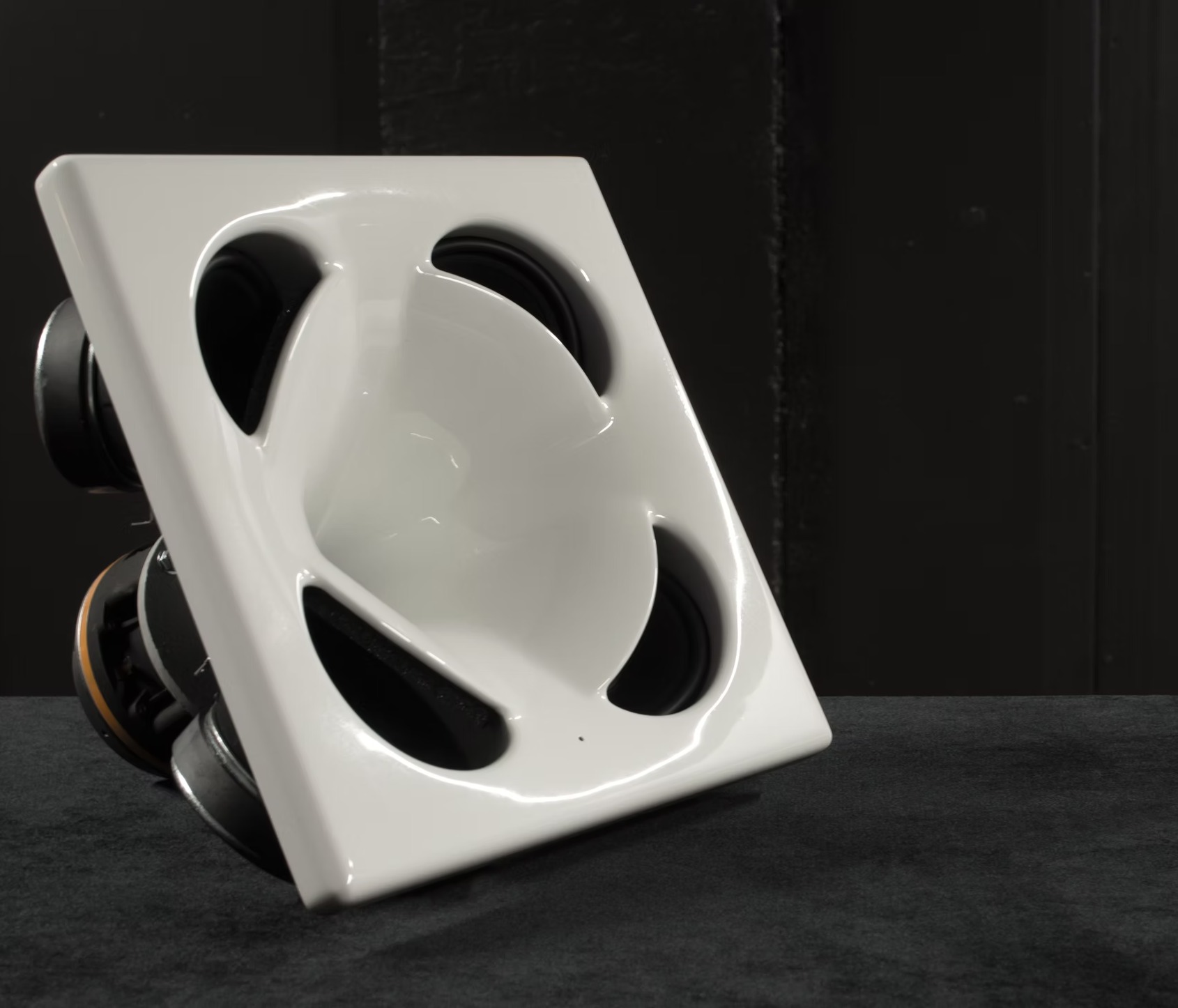
Square
Two
Cast front, 320 mm square
90° × 90° at 1 kHz, hor = ver
17 people
Every cabinet measured
A loudspeaker is a machine for moving air with almost no opinion of its own.
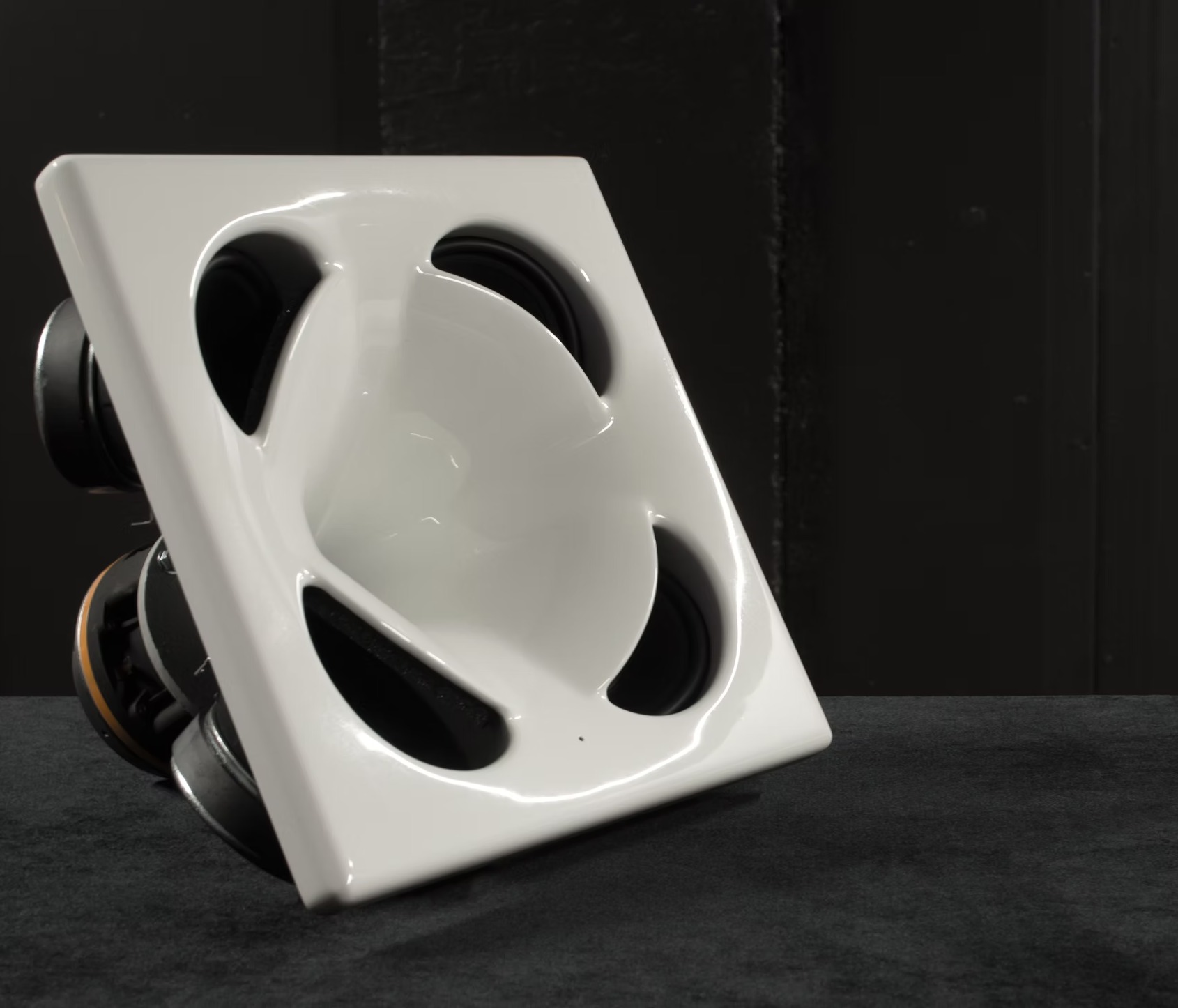
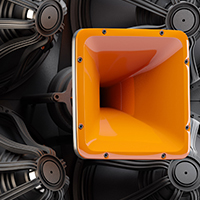
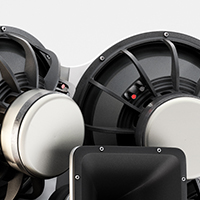
Square Two is built around a square constant-directivity horn. Four 5-inch woofers fire through bandpass chambers at the corners of the horn face, around a 1.4-inch compression driver on a machined throat. The crossover sits at 1 kHz, phase-linear from about 200 Hz using IIR filters alone, and by construction the pattern is the same horizontally and vertically.
The consequence is unglamorous and, we think, the point: the room hears the same thing the engineer does. Reflections arrive with the same spectrum as the direct sound, so what is wrong with a mix stays wrong wherever you stand.
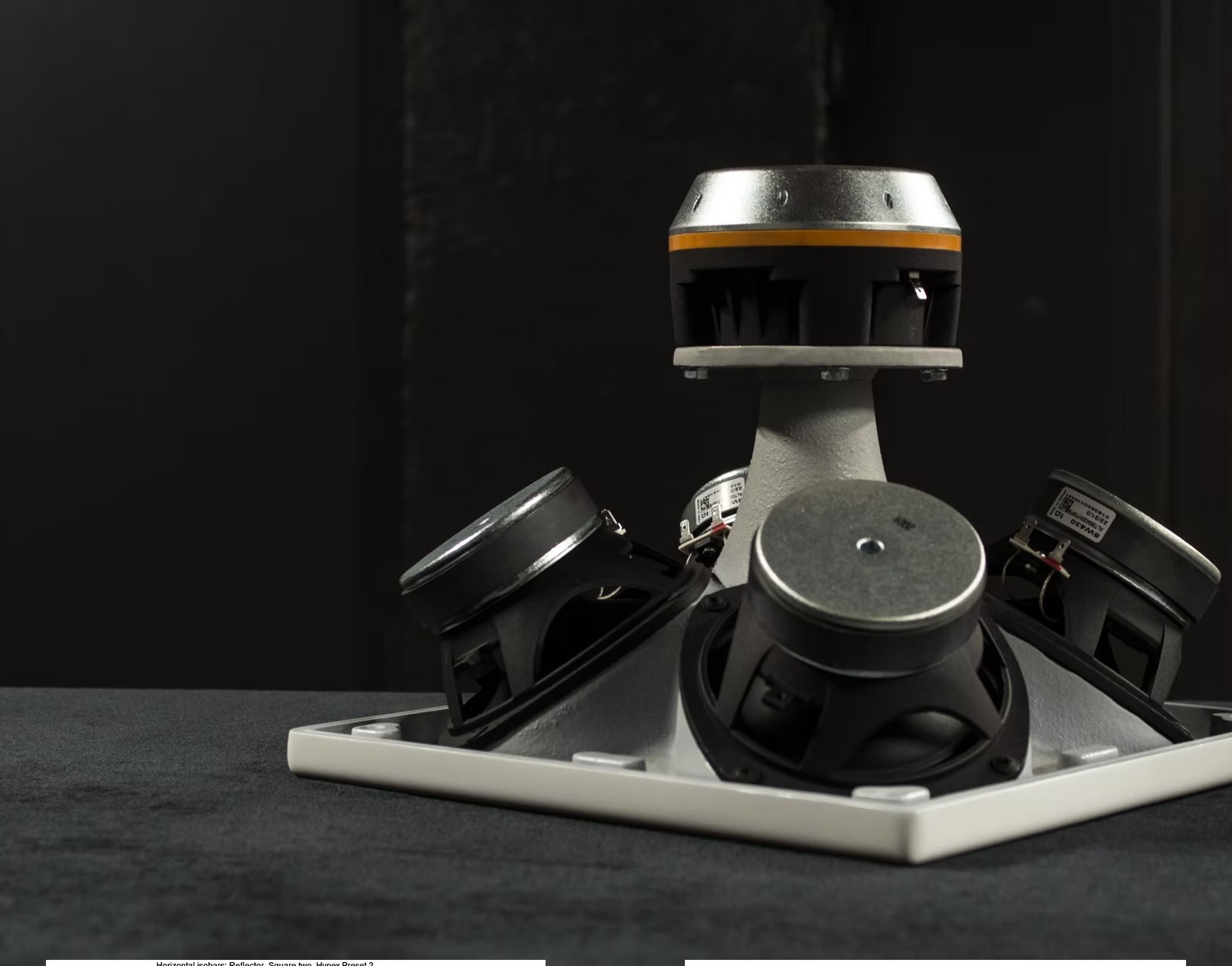
Four 5 in woofers, one 1.4 in throat
Sand-cast in Liepāja, stress-relieved for six weeks, then machined on a five-axis bed. The baffle is the structure, the heatsink and the horn at once. Nothing bolts to a panel.
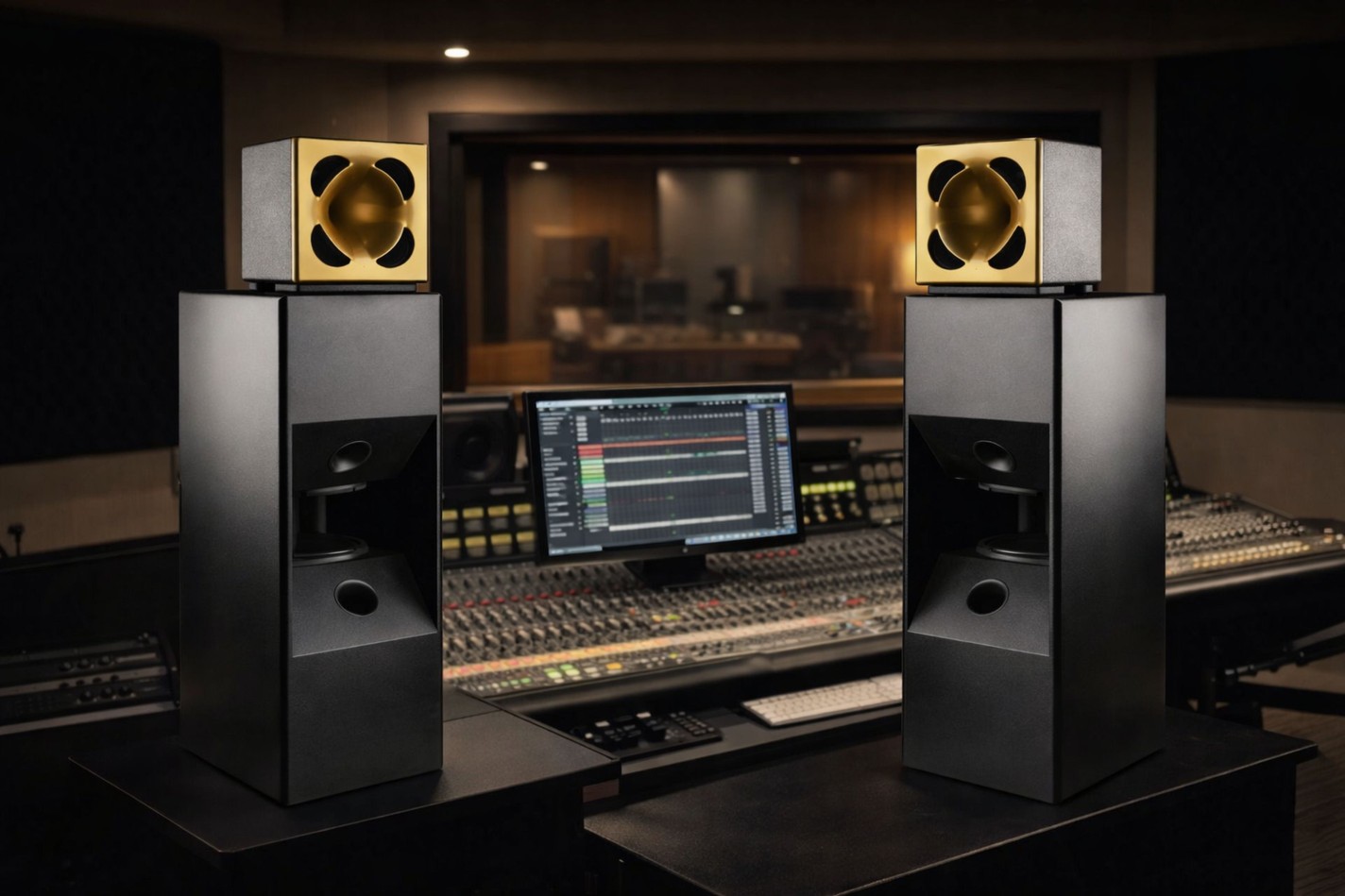
Ninety-one rooms have been calibrated around this array since 2019.
Square Two on cast plinths
Gold anodised throat
The square is the whole idea
Every model is the same geometry at a different scale: a square waveguide cut into a cast baffle, with the midrange drivers arranged around it rather than beneath it.
Because the pattern is constant, a small room and a large room are the same problem with different numbers. You do not relearn the loudspeaker when you change scale.
02 — Square Two / 320 mm
03 — Square Three / 520 mm
04 — Square Four / 640 mm
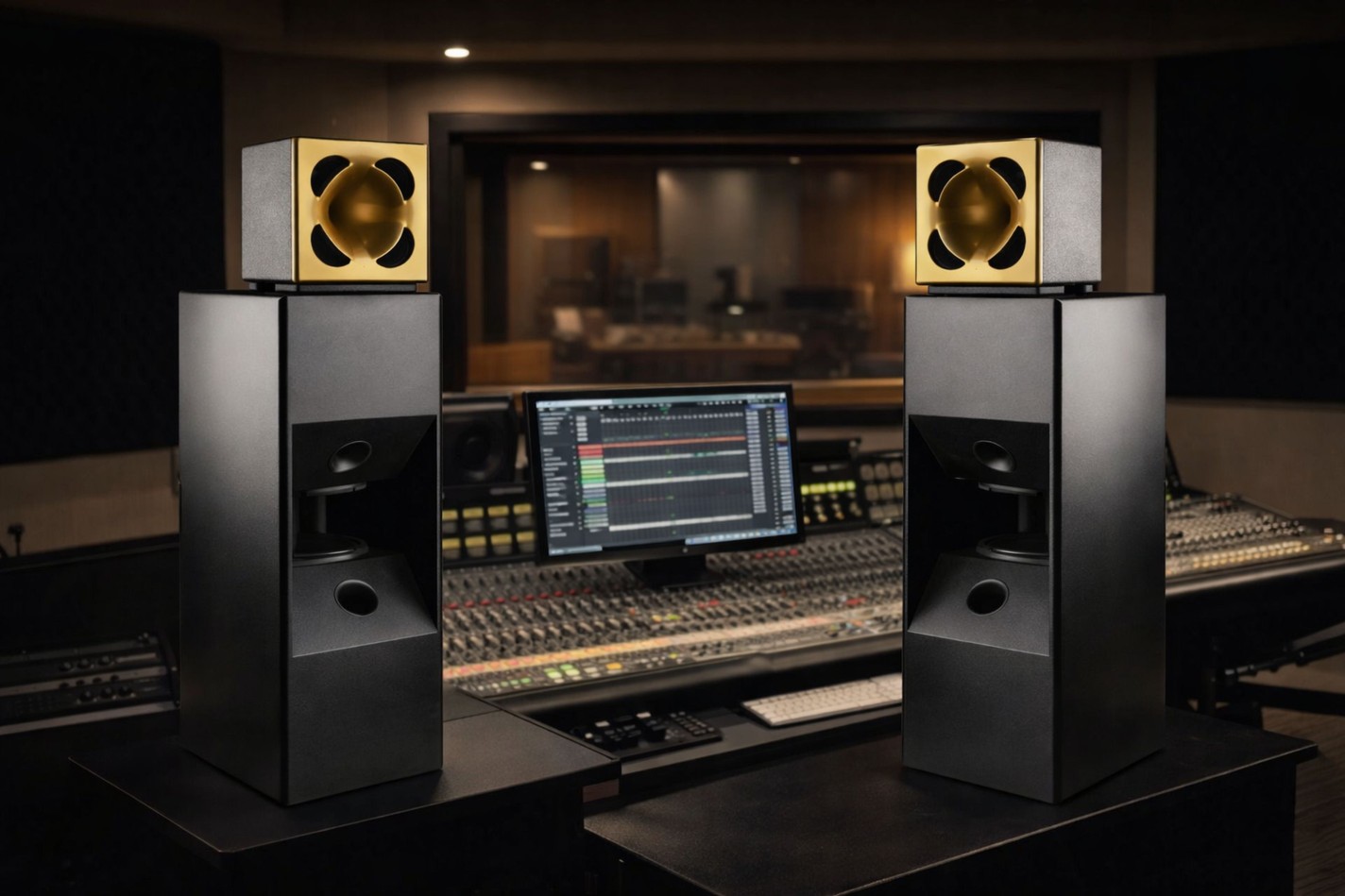
Square One
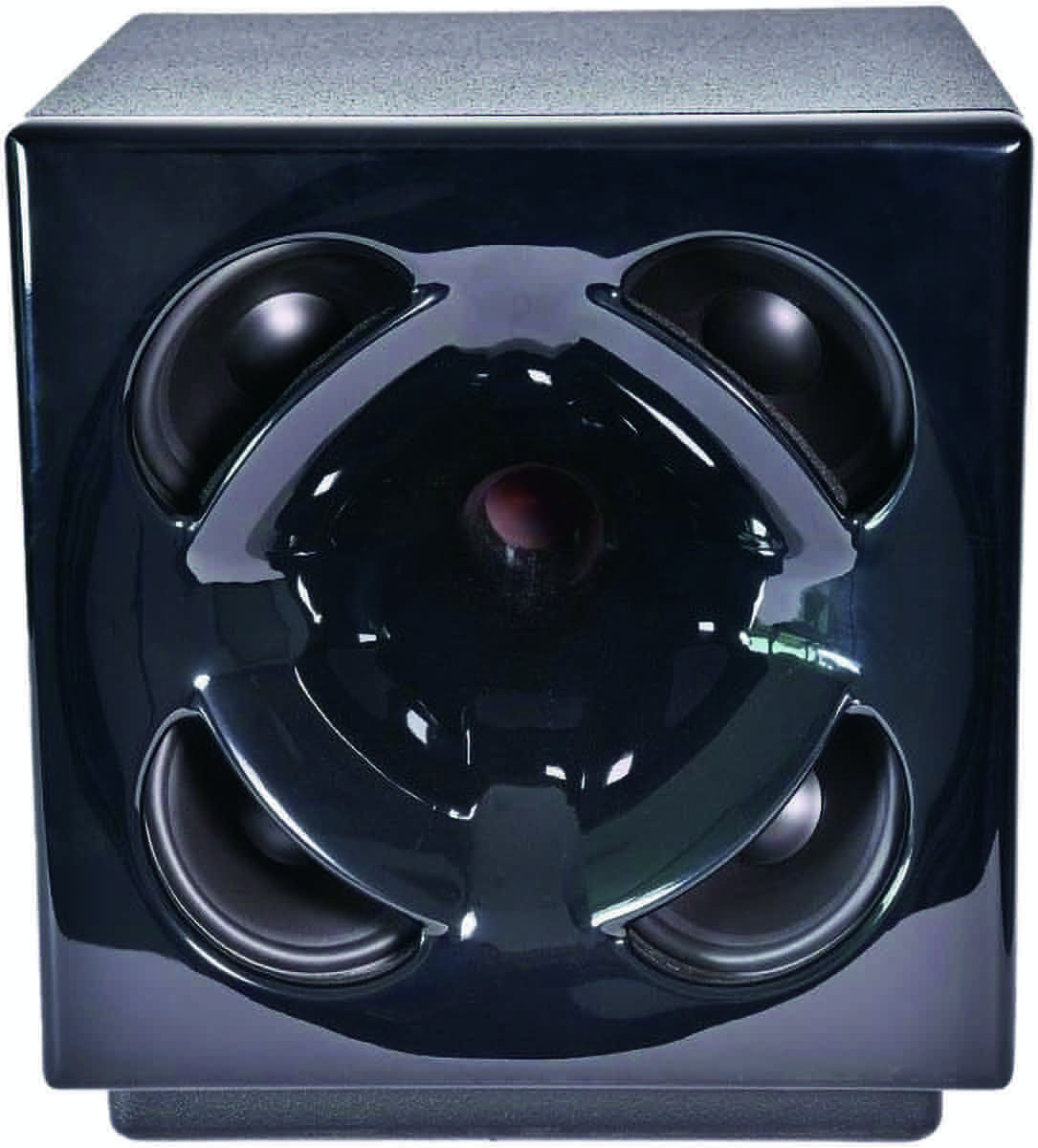
A 240 mm cube for desks and edit suites. Two 105 mm drivers flank a 25 mm throat in the same square waveguide, held to ±4° from 700 Hz. It is the smallest cabinet in which the geometry still behaves.
Square Two
Four 5-inch woofers around a 1.4-inch compression throat, Hypex Ncore amplification at 2 × 125 W + 100 W, and a cast front on a 19.4 kg enclosure. Crossed at 1 kHz, phase-linear from 200 Hz.
Ex works Rīga
Square Three
The 520 mm cabinet is what a control room over 55 m³ needs before it needs a soffit. Same array, larger throat, 1,850 W.
Square Four
Built to a room rather than to a catalogue. Twin 380 mm woofers in a sealed sub-chamber, the 640 mm array above, and a front baffle machined to the soffit angle of the room it will live in. Twelve to sixteen weeks.
Includes room survey
Rīga assembly floor
Square
Two
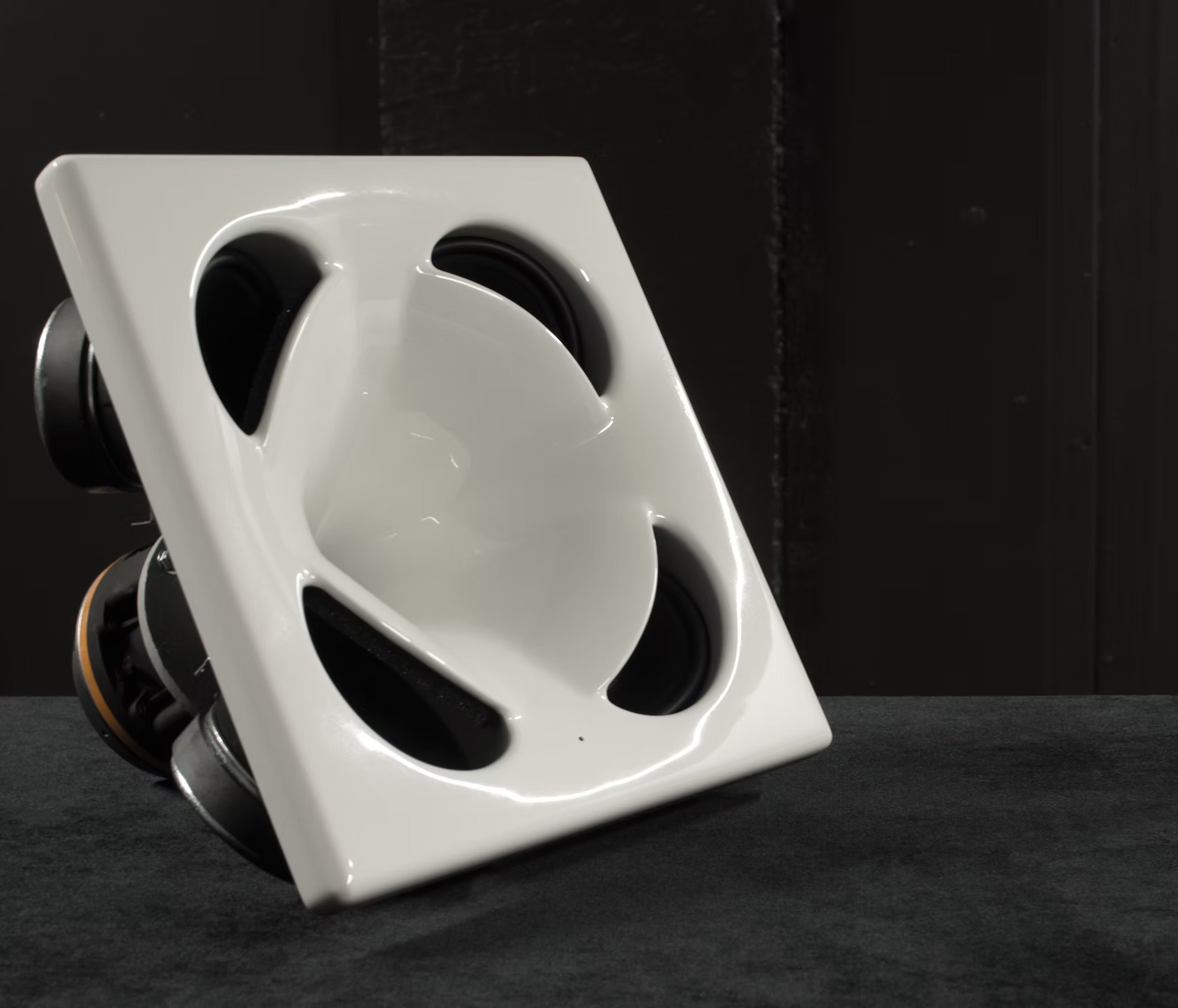
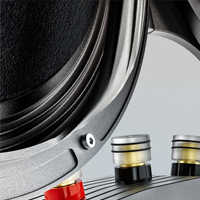
The face is one casting. The waveguide, the driver seats, the heatsink fins and the mounting bosses are cut from the same block of metal, so nothing in the acoustic path is bolted to anything else.
Machined ±0.05 mm
Six-week stress relief
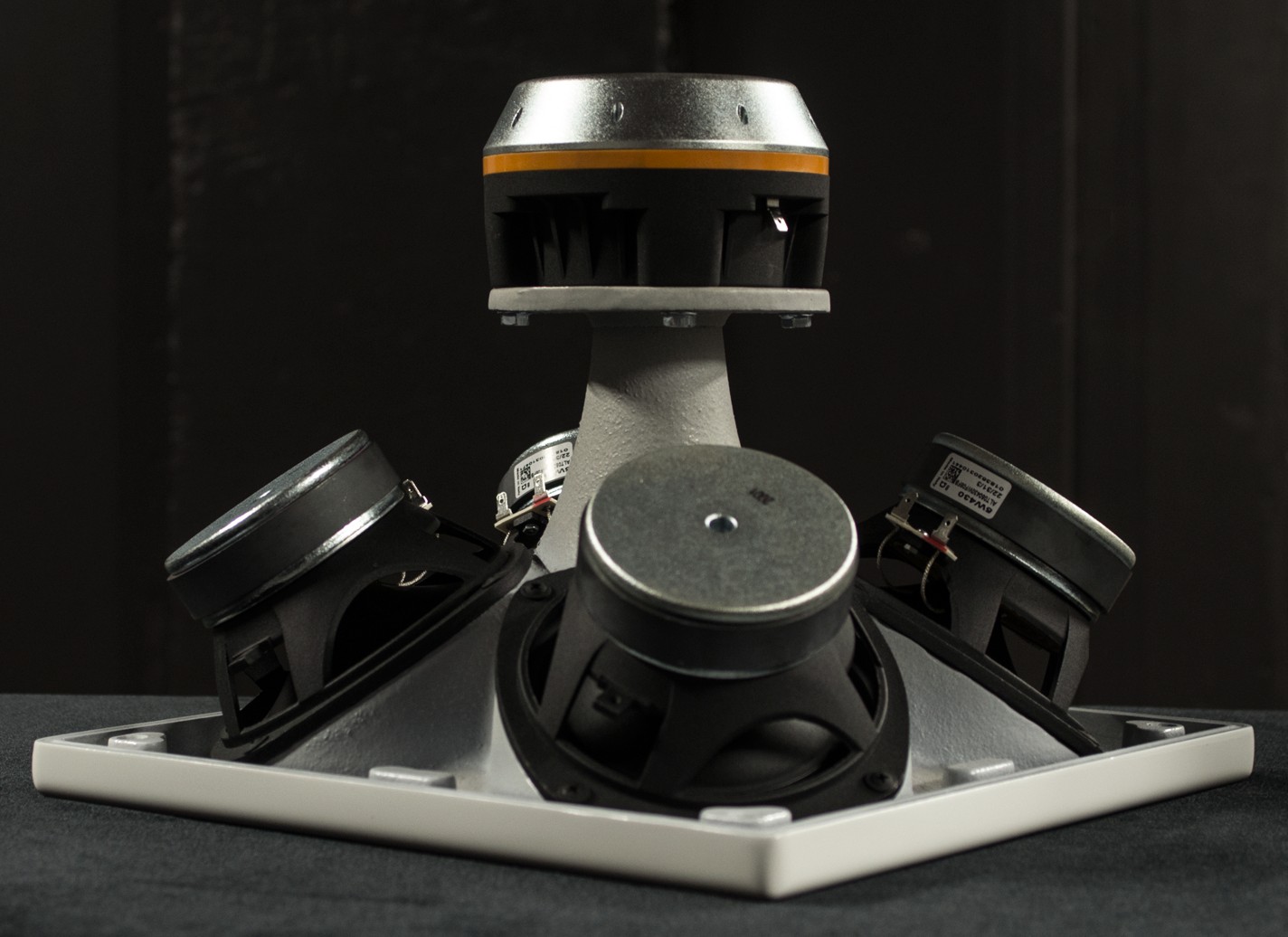
A 1.4-inch compression driver on a machined phase plug. Crossed at 1 kHz, phase-linear from about 200 Hz, entirely in DSP — IIR only, no FIR.
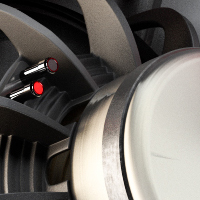
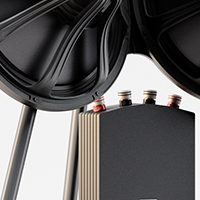
Four 5-inch woofers load bandpass chambers in the corners of the horn face. Summed, they present the same acoustic centre as the throat.
220 mm, sealed, 620 W. No port, so nothing to unload below tuning and no group delay to argue about.
18.4 kg of the 31 kg total. First panel resonance measured at 1.9 kHz, 42 dB below the driver output.
50° above 2 kHz — hor = ver
Pair, 3 % THD
Analogue in, linear phase off
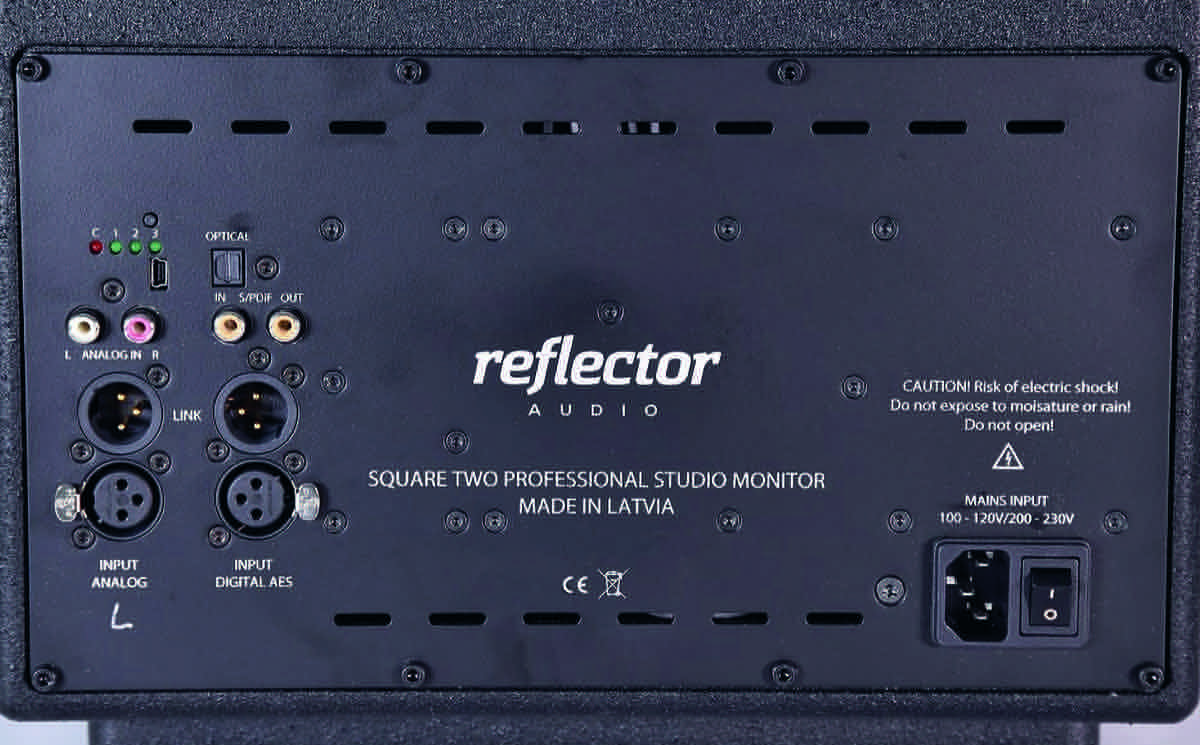
Everything is addressable, nothing is decorative
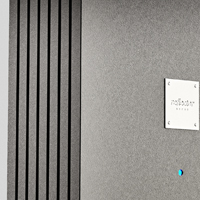
The panel is machined into the rear fin rather than screwed onto it. Serial number, calibration date and the measured deviation of that specific cabinet are etched on the plate.
Specify a pair
Constant
directivity
A loudspeaker radiates in every direction; a room returns most of it. If the off-axis energy has a different tonal balance from the direct sound, the room adds a colour that no amount of correction removes, because it is not an amplitude error — it is two different spectra arriving at different times.
A square waveguide with drivers at its corners keeps those two spectra the same. That is the entire engineering programme of this company, restated at four sizes.
The square throat
A round horn narrows as frequency rises. A square one, cut with a constant expansion in both axes, holds the same pattern in both planes: 90° at 1 kHz, tightening evenly to 50° above 2 kHz. The corners do the work a round mouth cannot.
Four drivers, one source
Midrange at the corners, angled inward, summing to an acoustic centre that sits inside the throat. Below the crossover the array is indistinguishable from a single driver of impossible size.
Metal, not board
Cast aluminium pushes the first cabinet resonance out of the working band. It also carries the heat of 350 W of class-D out through the same fins that stiffen the structure.
Correction, held back
DSP sets the crossover, the delay and the individual driver alignment. It is not asked to fix the room, and it is not asked to flatter the response. Linear phase is optional and off by default.
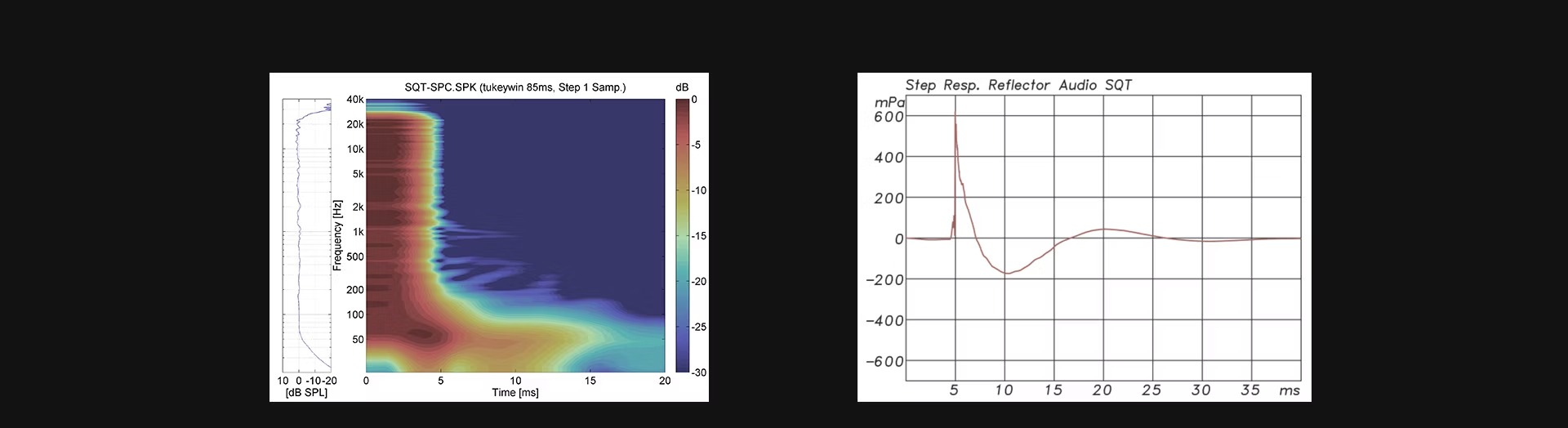
The contour map shows radiated level against angle and frequency. A well-behaved loudspeaker draws straight vertical edges: the pattern does not widen at the crossover and does not collapse at the top. Measured, Square Two runs 120° above 600 Hz, 90° at 1 kHz, 50° above 2 kHz — identical in both planes.
Under 1.2 ms across the audible band with linear phase disengaged. The rise below 60 Hz is the sealed alignment and is audible as a slightly drier low end, which is the trade we chose.
Every cabinet is measured before it leaves. The plot for your serial number is printed, signed, packed in the lid, and kept on file. Ask for it by serial at any point in the product's life.
Room correction you can read, argue with, and switch off
Align measures the room from the listening position, proposes a correction, and shows you exactly which filters it wants to apply and why. Nothing is hidden behind a single slider. Ninety-six memories, recallable per project, per engineer, or per client sitting in the room.
Free, unlicensed
Included with pair
CSV, REW, .txt
Ninety-one
rooms
A monitor earns its place by being boring in the right way for eleven hours.
Reflector cabinets are specified for tracking rooms, mix stages, mastering suites, broadcast and immersive post. The reason is the same in each case: the pattern does not change with level or frequency, so the room's contribution stays constant and predictable, and a decision made at 85 dB still holds at 70.
Every installation includes a room survey, on-site calibration by our engineer, and a printed measurement set for the room as delivered. Recalibration is free for the first three years.
Room references are given privately, with the studio's permission, at the demonstration stage. We do not publish client lists.
62 m³ · 2.4 m · gold throat
Bring your own programme material
Demonstrations run for two hours in a calibrated room, on your files, with an engineer present and nobody selling anything. Rīga, London, Berlin, New York and Los Angeles.
Specifications
Figures are measured, not modelled: anechoic at two metres, 1/24 octave, averaged over the first twelve units of each production run. Individual cabinets deviate by less than 0.4 dB from these values.
AES3, 44.1 — 192 kHz
AES67 / Dante, redundant
Word clock in / thru
Pearl, powder over cast
Graphite, low-reflectance
Gold, hard-anodised 24 µm
ITU-R BS.1116-3
AES75-2022 (SPL)
CE, UKCA, FCC part 15B
Drivers rebuilt, not replaced
Free recalibration, 3 years
Parts held for 20 years
Square Two
Kaspars in Rīga will write within one working day with the build date and the name of the engineer who will measure your pair. No payment has been taken.
Two hours, your files, no pitch
We will write within one working day with two or three dates and the address of the nearest calibrated room.
Bring stems, a reference master, or nothing at all. There is a Pro Tools rig, a Pyramix, and a turntable in most of the rooms.
24.13 E
0.08 W
13.40 E
73.94 W
118.31 W
139.69 E
Outside these cities we will send a pair to your room on a two-week trial, freight paid both ways, once we have talked about the room.
trade@reflector.audio
Owned,
not licensed
Everything needed to run, measure, service or rebuild a Reflector cabinet is published here without an account. Parts are held for twenty years from the end of a production run. Drivers are rebuilt in Rīga rather than swapped for a new pair.
Service
Send the cabinet, or the driver alone, to Rīga. Turnaround is eleven working days including a fresh measurement set. Freight is at our cost inside the warranty.
Recalibration
Free for three years, on site, anywhere we have an engineer. After that, at cost. Rooms change more than loudspeakers do.
Your serial's plots
Write with the number etched on the rear plate and we will send the original measurement set as a PDF and as raw CSV, whatever the year.
Speak to a person
Four engineers answer the support address, all of whom have built these cabinets. support@reflector.audio · +371 6 700 4120, weekdays 09:00–18:00 EET.