Reflector Audio — Riga, Latvia
Monitoring
without
a baffle.
A cabinet colours everything that leaves it. Square Two removes the baffle from the equation — four low-frequency drivers vent around a central coaxial horn, so the enclosure radiates as a single point source rather than a box with drivers in it.
One source,
not two.
The central mid/high horn is surrounded by four low-frequency drivers, each venting through its own opening. Acoustic centres align. The result behaves as one source across the crossover region instead of two sources arguing about where the image sits.
There is no flat front panel for sound to diffract from, and no cabinet volume large enough to store and re-release energy. What you hear is closer to what was recorded.
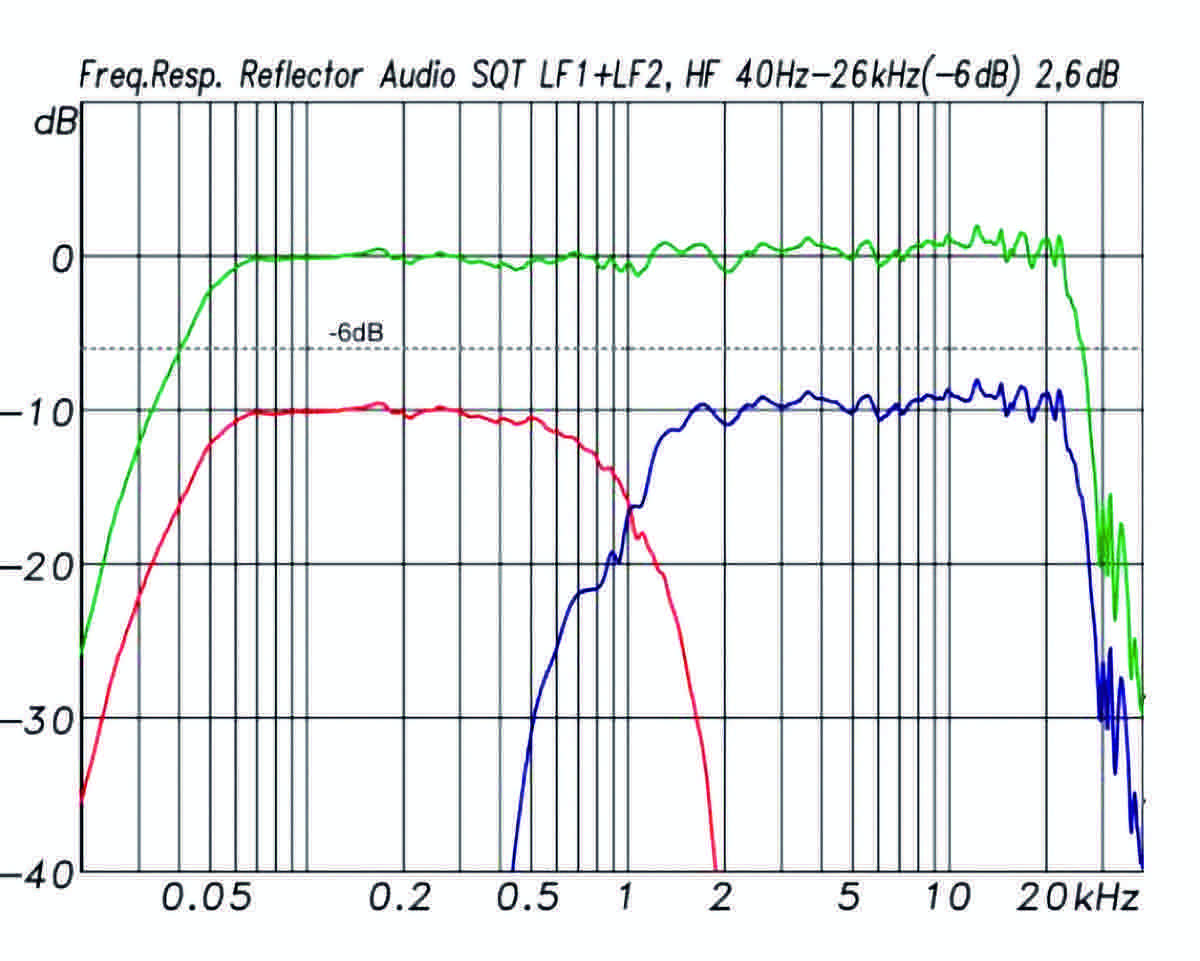
Flat is not a claim.
It is a measurement.
Built in Riga.
Tuned in your room.
01 / SQT
Square
Two
A coaxial point source in a 320 mm cube. Powered, two-way, and pair-matched to within half a decibel before it leaves Riga.
| Configuration | Powered two-way, coaxial horn, bass-reflex |
|---|---|
| Low frequency | 4 × 5 in Eighteen Sound, bandpass chambers |
| High frequency | 1.4 in FaitalPRO compression driver |
| Crossover | 1 kHz — phase-linear IIR, no FIR |
| Frequency range | 40 Hz – 26 kHz (−6 dB) |
| Max useful level | 112 dB (3% THD) · 118 dB peak |
| Directivity | 64° (−6 dB, 1–10 kHz), horizontal = vertical |
| Amplification | Hypex Ncore 2 × 125 W + 100 W, Sigma DSP |
| Pair matching | 0.35 dB |
| Enclosure | 320 × 345 × 325 mm · 19.4 kg |
| Bass extension | Optional three-way system — to 16 Hz, < 5 ms latency |
Configure
a pair.
Horn finish
Square Two · per pair
€ 5,990
INDICATIVE — CONFIGURED AT ORDER
- Delivered as a matched pair with measurement sheets
- Lead time 6–8 weeks from Riga
- SQB bass system can be added later — no trade-in required
Each pair is matched to within half a decibel before it leaves.
02 / Q1818
The
reference
system.
An impulse-corrected open-baffle array for recording, mixing and mastering rooms. Four 18-inch drivers, a compression driver, and no cabinet between you and the work.
| Configuration | Open-baffle reference, impulse-corrected |
|---|---|
| Array | 4 × 18 in + compression driver, coaxial |
| Low frequency | Additional 18 in subsystems, per room |
| Amplification | ≈ 10 kW Class D, passively cooled |
| Radiation | Figure-of-eight |
| Calibration | Tuned in-room, per control room |
| Availability | Made to order |
The room hears
less of itself.
A dipole radiates forward and backward, and almost nothing to the sides. Side-wall reflections — the ones that smear imaging in most control rooms — barely exist. What reaches you is the array, and the array is corrected in time.
The nulls at 90° are not a by-product. They are the point.
Not shipped.
Commissioned.
Consultation
Room drawings, monitoring history, what the room is for. We decide together whether Q1818 is the right answer.
Measurement
The room is measured before anything is built. The array is dimensioned against the space it will work in.
Build
Drivers are matched and the array is assembled in Riga. Every element is measured on its way in.
Tuning
The system is voiced in your room, by us, against the measurements. It is finished where it will be used.
No two rooms are identical, so no two systems are delivered the same.
03 / Method
Five decisions against the cabinet.
None of them are voicing choices. Each one removes a mechanism that was adding something the recording did not contain.
Baffle-free radiation
A baffle creates edge diffraction and a cabinet signature. Remove it and you remove both — there is no flat front for a wave to run off the edge of.
Horn loading
Controlled directivity and high sensitivity, so the driver works in a smaller and more linear part of its available excursion.
Coaxial arrangement
One acoustic origin instead of two. The image holds together as you move, rather than collapsing the moment you leave the sweet spot.
Impulse correction
Time-domain accuracy is corrected as a design target, not treated as a by-product of getting the frequency response flat.
Point-source behaviour
What arrives at the listening position is a single coherent wavefront, not the sum of several sources arriving at slightly different times.
We are not voicing a loudspeaker. We are trying to hand back the recording with its temporal and spatial information intact.
04 / Company
Instrument makers, not a factory.
Reflector Audio designs, builds and measures its loudspeakers in Riga. The team is small on purpose — every pair that leaves has been listened to by the people who made it.
The first baffle-free prototype is built and measured. The idea holds.
Reflector Audio Design, SIA — the company forms around the prototype, in Riga.
Q1818 is shown in Anaheim. The reference system leaves the lab.
United States patent on the loudspeaker structural technology.
- Research
- Manufacturing
- Measurement · QC
- Brand
- Demonstrations
- Brand
- Demonstrations
Measured on the way in.
Listened to on the way out.
Drivers are matched before assembly. Finished pairs are measured against each other and against the reference curve, then auditioned. The measurement sheets travel in the crate — the numbers belong to the owner, not to marketing.
A small team.
One pair at a time.
05 / Contact
Talk to the people who build it.
Listening rooms in Riga, New York and Los Angeles, by appointment. Tell us about your room — we answer within two working days.
RECEIVED · REF RA-000000
Thank you.
We answer within two working days. If it is urgent, say so in a second message and we will move faster.
- Factory listening room
- In-room tuning departs here
- Demonstrations by appointment
- Demonstrations by appointment
listen@reflectoraudio.com